Traditional language models (LLMs) process text one word at a time.
They predict the next token based on the ones before it.
That works well, but it’s not how humans think.
When we write or speak, we don’t just string words together.
We organize our thoughts into sentences, ideas, and concepts.
That’s where Large Concept Models (LCMs) come in.
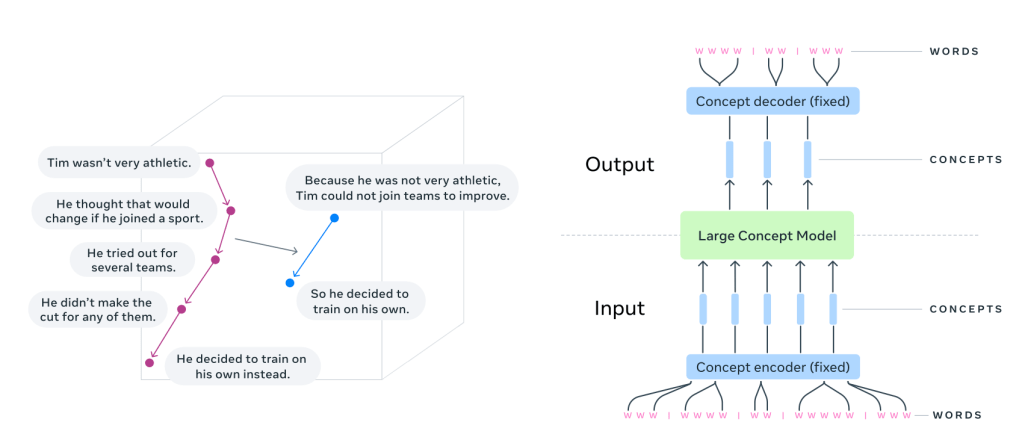
Instead of predicting the next word, LCMs predict the next sentence.
Each sentence is treated as a concept — a standalone unit of meaning.
That’s a big shift.
Why does this matter?
LLMs operate at the token level, making them great at text generation but limited in their ability to reason hierarchically. They tend to get lost in long-form content, struggle with consistency, and often fail to keep track of structured ideas.
LCMs take a different approach. They generate text in sentence embeddings, operating in a high-dimensional space (like SONAR) instead of token sequences. Instead of focusing on words, they predict thoughts in a way that’s language- and modality-agnostic.
This has big implications:
Better context understanding — By modeling entire sentences as units, LCMs improve coherence and logical flow.
Multilingual and multimodal — Trained on 200+ languages, LCMs can generalize across text and speech without additional fine-tuning.
More efficient generation — Since they work at a higher level, they process fewer steps, making them faster and more scalable than token-based models.
Stronger zero-shot performance — LCMs outperform LLMs of the same size in summarization and text expansion tasks, even in languages they weren’t explicitly trained on.
The technical shift
LLMs generate text autoregressively, predicting one token at a time. This requires them to process long token sequences and maintain coherence through implicit context modeling.
LCMs, on the other hand, predict the next sentence embedding in a latent space.
Instead of raw tokens, they work with sentence representations from SONAR, a multilingual embedding model.
SONAR is trained to encode and decode sentences across 200+ languages into and out of a single shared representation space. When an LCM needs to handle a new language or modality, only the SONAR encoder/decoder must be updated — leaving the central model untouched.
The embeddings are processed autoregressively using diffusion models, MSE regression, or quantized representations — allowing LCMs to generalize across languages and modalities without needing explicit tokenization.
This shift reduces computational complexity, makes it easier to edit long-form text, and allows AI to reason at a higher level of abstraction.
The results
When tested on summarization and summary expansion, LCMs outperformed traditional LLMs of the same size.
They showed strong generalization across multiple languages — without additional fine-tuning.
They handled long-form text more coherently than token-based models.
And because they work in a modular embedding space, they can be extended to new languages, speech, or even sign language, without retraining the entire model.
Challenges
Sentence splitting
LCMs rely on robust sentence segmentation. Very long or tricky “sentences” can hurt performance.
Out-of-distribution embeddings
With MSE or diffusion, the model could predict vectors that don’t perfectly map back to valid text. Diffusion or well-tuned quantization helps mitigate this.
Averaging vs. sampling
A purely MSE-based approach might average all potential continuations into a single “blurry” embedding. Diffusion or discrete codebooks allow multiple plausible completions.
The Future of Language Modeling?
LLMs work. But they are word-by-word prediction machines.
LCMs take a different path — one that focuses on thoughts, not just tokens.
By modeling language at the concept level, they bring AI closer to how humans structure ideas.
This isn’t just an optimization. It’s a fundamental shift in how AI understands and generates language.
And it might just change how we build the next generation of intelligent systems.
Chatbots are becoming more powerful and accessible than ever. In this tutorial, you’ll learn how to build a simple chatbot using Streamlit and OpenAI’s API in just a few minutes.
Prerequisites
Before we start coding, make sure you have the following:
Python installed on your computer
A code editor (I recommend Cursor, but you can use VS Code, PyCharm, etc.)
An OpenAI API key (we’ll generate one shortly)
A GitHub account (for deployment)
Step 1: Setting Up the Project
We’ll use Poetry for dependency management. It simplifies package installation and versioning.
Initialize the Project
Open your terminal and run:
# Initialize a new Poetry project
poetry init

# Create a virtual environment and activate it
poetry shell
Install Dependencies
Next, install the required packages:
poetry add streamlit openai
Set Up OpenAI API Key
Go to OpenAI and get your API key. Then, create a .streamlit/secrets.toml file and add:
OPENAI_API_KEY="your-openai-api-key"
Make sure to never expose this key in public repositories!
Step 2: Creating the Chat Interface
Now, let’s build our chatbot’s UI. Create a new folder: streamlit-chatbot, and add a file to it, called app.py with the following code:
import streamlit as st
from openai import OpenAI

# Access the API key from Streamlit secrets
api_key = st.secrets["OPENAI_API_KEY"]
client = OpenAI(api_key=api_key)
st.title("Simple Chatbot")

# Initialize chat history
if "messages" not in st.session_state:
    st.session_state.messages = []

# Display previous chat messages
for message in st.session_state.messages:
    with st.chat_message(message["role"]):
        st.markdown(message["content"])

# Chat input
if prompt := st.chat_input("What's on your mind?"):
    st.session_state.messages.append(
       {"role": "user", "content": prompt}
    )
    with st.chat_message("user"):
        st.markdown(prompt)
This creates a simple UI where:
The chatbot maintains a conversation history.
Users can type their messages into an input field.
Messages are displayed dynamically.
Step 3: Integrating OpenAI API
Now, let’s add the AI response logic:
# Get assistant response
    with st.chat_message("assistant"):
        response = client.chat.completions.create(
            model="gpt-3.5-turbo",
            messages=[
              {"role": m["role"],
               "content": m["content"]} for m in st.session_state.messages
            ])
        assistant_response = response.choices[0].message.content
        st.markdown(assistant_response)

    # Add assistant response to chat history
    st.session_state.messages.append({"role": "assistant", "content": assistant_response})
This code:
Sends the conversation history to OpenAI’s GPT-3.5-Turbo model.
Retrieves and displays the assistant’s response.
Saves the response in the chat history.
Step 4: Deploying the Chatbot
Let’s make our chatbot accessible online by deploying it to Streamlit Cloud.
Initialize Git and Push to GitHub
Run these commands in your project folder:
git init
git add .
git commit -m "Initial commit"
Create a new repository on GitHub and do not initialize it with a README. Then, push your code:
Machine learning models typically predict outcomes based on what they’ve seen — but what about what they haven’t?
Google tackled this issue by integrating causal reasoning into its ML training, optimizing when to show Google Drive results in Gmail search.
The result?
A 9.15% increase in click-through rates without costly A/B tests.
Let’s break it down.
The problem: biased observational data
Traditional ML models train on historical user behavior, assuming that past actions predict future outcomes.
But this approach is inherently biased because it only accounts for what actually happened — not what could have happened under different conditions.
Example: Gmail sometimes displays Google Drive results in search. If a user clicks, does that mean they needed the result? If they don’t click, would they have clicked if Drive results were presented differently?
Standard ML models can’t answer these counterfactual questions.
Google’s approach: Causal ML in action
Instead of treating all users the same, Google’s model categorized them into four response types based on their likelihood to click:
Compliers — Click only if Drive results are shown.
Always-Takers — Click regardless of whether results are shown.
Never-Takers — Never click Drive results.
Defiers — Click only if Drive results are not shown (a rare edge case).
The challenge? You can’t directly observe these categories — a user only experiences one version of reality.
Google solved this by estimating counterfactual probabilities, essentially asking: How likely is a user to click if the result were shown, given that it wasn’t?
The key insight: optimizing for the right users
Instead of optimizing blindly for clicks, the model focused on:
Prioritizing Compliers (since they benefit the most from Drive results).
Accounting for Always-Takers (who don’t need Drive suggestions to click).
This logic was embedded into the training objective function, ensuring that the model learned from causal relationships rather than just surface-level patterns.
The Results: Smarter Personalization Without Experiments
By integrating causal logic into ML training, Google achieved:
+9.15% increase in click-through rate (CTR)
Only +1.4% increase in resource usage (not statistically significant)
No need for costly A/B testing
This proves that causal modeling can reduce bias in implicit feedback, making machine learning models more adaptive, efficient, and user-friendly — all without disrupting the user experience.
Why This Matters
Most companies rely on A/B testing to optimize product features, but sometimes that approach can be expensive, or just not possible at all.
Causal ML offers a way to refine decisions without running thousands of real-world experiments.
Google’s work shows that the future of ML isn’t just about better predictions — it’s about understanding why users behave the way they do and making decisions accordingly.
My top 10 book picks from 2024, to help you build your 2025 reading list
This year, for some reason, I found myself reading a lot more than usual — 52 books in total — without even pushing myself.
I think it happened naturally because I bought many books that genuinely interested me (I also tackled some really short ones, to be fair).
Here are some of the best books I read this year to help you build your reading list for 2025.
But before we dive in, you might be wondering why bother with this. Why create a reading list or read books at all? Well, reading is one of the best things you can do for yourself. There’s so much knowledge out there from experts in various fields — Nobel laureates, Harvard PhDs, and more. Books are affordable, and most of them are really enjoyable to read.
And why books? Why not just read blog posts?
A good book is like a painting: the author invests a lot of time, does extensive research, and works tirelessly to distill their ideas into the pages. That effort really shows.
Good books have layers and depth. Re-reading them reveals new insights each time.
This applies to both fiction and non-fiction. These days, self-development books are selling really well, partly because their titles are so straightforward: “How to Win Friends and Influence People,” “How to Talk to Anyone,” “Think and Grow Rich”.
There’s nothing wrong with that, but remember that many of those lessons can also be found in fiction, presented in a more friendly and subtle way.
Plus, reading doesn’t have to be just for learning — it can also be purely for fun!
Personally, I like to mix things up. This year, I read a lot of fiction, economics, and data science books.
Now, onto the list.
Less Technical Stuff
Build
Tony Fadell’s memoir and practical guide for entrepreneurs offers insights from his experiences designing iconic products like the iPod and Nest.
It’s a rare book written by someone who has actually built things. It covers everything from HR to marketing to legal issues and walks you through the different stages of building a business — from working on a product with a small team to managing an organization of over 400 people.
The Capitalist Manifesto
This book argues in favor of capitalism as the ultimate system for freedom, innovation, and wealth creation.
Contrary to popular belief, global free-market capitalism has been the main driver of prosperity, reduced inequality, and fostered innovation over the past few centuries.
While some of the author’s claims come across as naive and heavily biased toward capitalism (for example, suggesting capitalism has a net positive impact on the environment), most arguments are solid and backed by strong data. Absolutely worth reading.
The Chronicles of Narnia
A classic fantasy series by C.S. Lewis about children discovering a magical world full of adventure, talking animals, and profound moral lessons.
The seven books are an allegory of biblical stories, spanning from the creation of Narnia to its end. Remember Aslan, the talking lion from the movies? He symbolizes God, which is made very clear in the books, as he serves as a benevolent and just king/father figure.
Though I’m not religious, I found it fascinating to see the lessons built into the narrative. Regardless of your beliefs, many of these lessons are universal, and reading these books with your children can be a great way to pass those values on.
Educated
Tara Westover’s memoir chronicles her journey from an isolated, fundamentalist upbringing to pursuing education and self-discovery. I couldn’t put it down.
Tara’s parents were extreme conspiracy theorists who refused to send their kids to school or take them to the hospital, believing these institutions were part of a larger scheme to control people. While their worldview might seem absurd at first, it’s heartbreaking to see its impact on their children.
Despite this, Tara managed to escape that environment and eventually earned a doctorate from the University of Cambridge. Safe to say, she turned out okay.
The Power of Creative Destruction
This book explores how innovation drives economic growth and progress by disrupting and replacing outdated systems.
For me, the main takeaway is that demonizing either free-market competition or state intervention doesn’t make sense. Both are necessary, and the book does a great job explaining when government intervention is helpful and when it can cause more harm than good.
Factfulness
This book illustrates global progress by plotting GDP per capita against life expectancy and categorizing countries into four development levels along this axis.
Interestingly, most countries fall in the middle, with only a few being extremely poor or very rich. Almost all countries, however, are moving in the right direction.
It’s remarkable how life has improved globally over the past 100 years. What’s even more surprising is how wrong people often are about the current state of the world. The author surveyed people worldwide, asking specific questions about statistics like vaccination rates, and the results showed widespread pessimism.
This negativity is partly due to the media’s tendency to focus on bad news. While the world isn’t perfect, things are steadily improving, and this book is a great reminder of that.
More Technical Stuff
Fundamentals of Software Architecture
Especially with the rise of generative AI, we’re often asked to build tools that don’t require much data science — just smartly calling APIs and wrapping them in a Streamlit interface.
This calls for a better understanding of software architecture.
All data scientists can benefit from learning software architecture principles. We tend to focus heavily on coding without understanding how our work fits into larger systems. This book offers a comprehensive guide to designing better systems.
Clean Code
A practical guide to writing clean, maintainable, and efficient code, this is a classic in the field.
It’s particularly useful for data scientists like me, who learned coding through Jupyter notebooks and picked up some bad habits along the way. Trust me, clean code matters — it improves readability and reduces bugs.
While it’s a great book, much of it could be distilled into a list of dos and don’ts (which I might create in a future story). However, keep in mind it’s very Java-specific.
System Design Interview
This preparation guide for system design interviews explains frameworks and best practices in a clear, concise way, making it easy to understand.
It’s a great starting point for learning system design concepts, regardless of whether you actually have an interview coming or not.
Causal Inference in Python
This hands-on guide shows how to apply causal inference methods using Python for real-world data science problems.
It borrows heavily from econometrics, so it’s an excellent resource if you come from that background. If your prior exposure to causality has been through machine-learning-focused sources, this book provides a refreshing new perspective.
Memory, reasoning, and the future of intelligent systems
AI is shifting from passive assistants to active problem solvers. Instead of just generating text based on a prompt, AI agents retrieve live information, use external tools, and execute actions.
Think of the difference between a search engine and a research assistant. One provides a list of links. The other finds, summarizes, and cross-checks relevant sources before presenting a well-formed answer. That’s what AI agents do.
Let’s break down how they work, why they matter, and how you can build one yourself.
Why AI Agents?
Traditional GenAI applications can generate convincing answers but lack:
Tools: They can’t fetch real-time data or perform actions.
Reasoning structure: They sometimes jump to conclusions without checking their work.
AI agents solve these issues by integrating tool usage, and structured reasoning.
Take a financial analyst, for example. Instead of manually searching for Apple’s stock performance, reading reports, and comparing it to recent IPOs, she could use an agent to:
1. Retrieve live stock data from an API.
2. Pull market news from a financial database.
3. Run calculations on trends and generate a summary.
No wasted clicks. No sifting through search results. Just a concise, actionable report.
How AI Agents Work
AI agents combine three essential components:
1. The model (Language understanding & reasoning)
This is the core AI system, typically based on an LLM like GPT-4, Gemini, or Llama. It handles natural language understanding, reasoning, and decision-making.
2. Tools (external data & action execution)
Unlike standalone models, agents don’t rely solely on their training data.
They use APIs, databases, and function calls to retrieve real-time information or perform actions.
Common tools include:
Search engines for fetching up-to-date information.
Financial APIs for stock prices, economic reports, or currency exchange rates.
Weather APIs for real-time forecasts.
Company databases for business insights.
3. The Orchestration Layer (Planning & Execution)
This is what makes an agent more than just a chatbot. The orchestration layer manages:
Memory: Keeping track of previous interactions.
Decision-making: Deciding when to retrieve information vs. generating a response.
Multi-step execution: Breaking down complex tasks into logical steps.
It ensures that the agent follows structured reasoning instead of blindly generating an answer.
Thinking Before Acting: The ReAct Approach
One of the biggest improvements in AI agent design is ReAct (Reason + Act). Instead of immediately answering a question, the agent first:
1. Thinks through the problem, breaking it into smaller steps.
2. Calls a tool (if needed) to gather relevant information.
3. Refines its answer based on the retrieved data.
Without this structure, models can confidently hallucinate — generating incorrect information with complete certainty.
ReAct reduces that risk by enforcing a step-by-step thought process.
Example
Without ReAct:
Q: What’s the tallest building in Paris?
A: The Eiffel Tower.
(Sounds reasonable, but wrong. The Montparnasse Tower is taller if you exclude antennas.)
With ReAct:
Q: What’s the tallest building in Paris?
Agent:
1. “First, let me check the list of tall buildings in Paris.” (Calls search tool)
2. “The tallest building is Tour Montparnasse at 210 meters.” (Provides correct answer)
This approach ensures accuracy by retrieving data when necessary rather than relying on training data alone.
AI Agents in Action: Real-World Examples
Let’s explore some concrete applications with the smolagents framework, by HuggingFace.
from smolagents import CodeAgent, DuckDuckGoSearchTool, HfApiModel

model = HfApiModel()
agent = CodeAgent(tools=[DuckDuckGoSearchTool()], model=model)

query = "Compare Apple's stock performance this week to major tech IPOs."
response = agent.run(query)
print(response)
What happens here?
1. The agent searches for stock performance data using DuckDuckGo’s API.
2. It retrieves relevant comparisons between Apple and newly public companies.
3. If needed, it could summarize key financial trends.
Instead of giving a vague answer like “Apple’s stock is up”, the agent provides a structured comparison, making it more useful.
This example uses an existing search tool, but the smolagents framework allows you to build your own: it could be calling an API or writing in a database, sending an email.
Any Python function, really.
The Future of AI Agents
AI agents are shifting how we interact with AI.
Instead of just responding to prompts, they make decisions based on logic, and call external tools.
Where Are We Headed?
1. Multi-Agent Systems — Teams of specialized AI agents working together.
2. Self-Improving Agents — Agents that refine their own strategies based on past interactions.
3. Embedded AI — Assistants woven into workflows that anticipate problems before they arise.
AI isn’t just answering questions anymore — it’s solving problems.
Final Thoughts
The difference between an AI model and an AI agent is the difference between knowing and doing.
A model like ChatGPT is an information engine. It predicts words based on patterns.
An agent is an action engine. It retrieves data, runs calculations, and executes tasks.
This shift — from static responses to dynamic, tool-enabled intelligence — is where AI is headed.
The real challenge now isn’t just improving models, but designing intelligent, adaptive systems that can reason, act, and learn over time.
AI agents will augment human decision-making, making us faster, more informed, and better equipped to navigate an increasingly complex world.
A quantitative exploration of the relationship between technology, labor and wealth
I see many people say AI will take our jobs any time now, based on the following narrative: the better AI becomes, the less companies will need us, therefore we will be replaced.
It’s an interesting chain of thought, but does it have the empirical basis to back it up? In other words, does reality match the story? Well, it doesn’t seem so.
It’s common to engage in this sort of discussion with well-thought arguments, based purely on conjectures, without looking at the existing body of scientific work nor at the data. I propose we take a tour of those two dimensions, to see if we can learn a thing or two from the empirical evidence.
Before we start, there is one link we need to establish: technology increases productivity. Here, we are talking from an economics perspective. Don’t think “when I have my cellphone I can’t work as much”. Here we are looking more at “the more technology in the world, the more we can produce with the same amount of work”.
This phenomenon is explained by the ability of technology to automate tasks, streamline processes, and facilitate the creation of new products and services. The intrinsic connection between technology and productivity is fundamental to understanding everything else you will read here.
With that out of the way, let’s see what science and data have to say about the impact of AI on our jobs.
Scientific work
Will AI take our jobs? This question can be seen as a specific case of the broader, more strucured question “does technology increase unemployment?”.
Unsurprisingly, this question has been asked by researchers many times before: a meta-analysis from 2022 that looked at 127 studies concluded that there is more evidence suggesting that technology creates net jobs than the other way around [1]. Their analysis specifically focuses on industrialized economies, to capture technological change at the frontier. They have also explored how this effect can be different depending on how we look at technology, but we will talk more about this later.
Some of the fear of AI comes from the narrative that, since AI makes us more productive, companies will need less of us to do the same job and, therefore, they will hire less of us. So, another study, from the European Central Bank [2], looked at the more general question “does productivity growth threaten employment?”. It turns out the answer is no. Even though some industries with higher productivity have seen fewer jobs, overall, the growth in productivity hasn’t really harmed employment. The study shows that one industry becoming more productive doesn’t automatically mean it will hire more people. However, it suggests that the positive impacts of productivity in one area can still create more jobs in other parts of the economy, offsetting any job losses in sectors with productivity gains. So, in the big picture, productivity growth has actually led to more jobs across various sectors. This study also concluded that current technology advances might bring a positive contribution to net jobs:
[…] the source of productivity growth matters for its aggregate employment consequences. Given that service sector productivity growth appears to have relatively strong employment spillovers, our findings suggest that the productivity growth spurred by the spread of (ultimately) general-purpose technologies such as robotics from heavy industry and into services may prove a boon for employment growth.
Anothery interesting study, from the OECD [3], spanning 13 countries over two decades, investigates the relationship between productivity, employment, and wages. It found a positive correlation between productivity growth and increased employment and wages, both at the firm and aggregate levels:
At the more aggregate level, the role of reallocation and links across industries becomes more evident. Yet also here, results confirm that productivity growth is, overall, associated with positive changes in employment and wages. Increasing employment among expanding firms tends to outweigh decreasing employment in shrinking or exiting firms. Furthermore, productivity gains at the industry level contribute to stronger employment growth in downstream industries through value chains.
Looking at AI more specifically, a panel study from 2023 shows evidence that it decreases the level of unemployment, at least in high-tech developed countries [4]. The study investigated how AI affects unemployment in 24 high-tech developed countries from 2005 to 2021, using Google Trend Index data related to AI and unemployment rates.
Data
Now, for some extra context, let’s take the time to explore some of the data ourselves, to answer some broeader questions. If technology is evolving (and I don’t think anyone questions that), and this is not decreasing the number of jobs available, then what is it doing for us?
We are not necessarily “less employed”
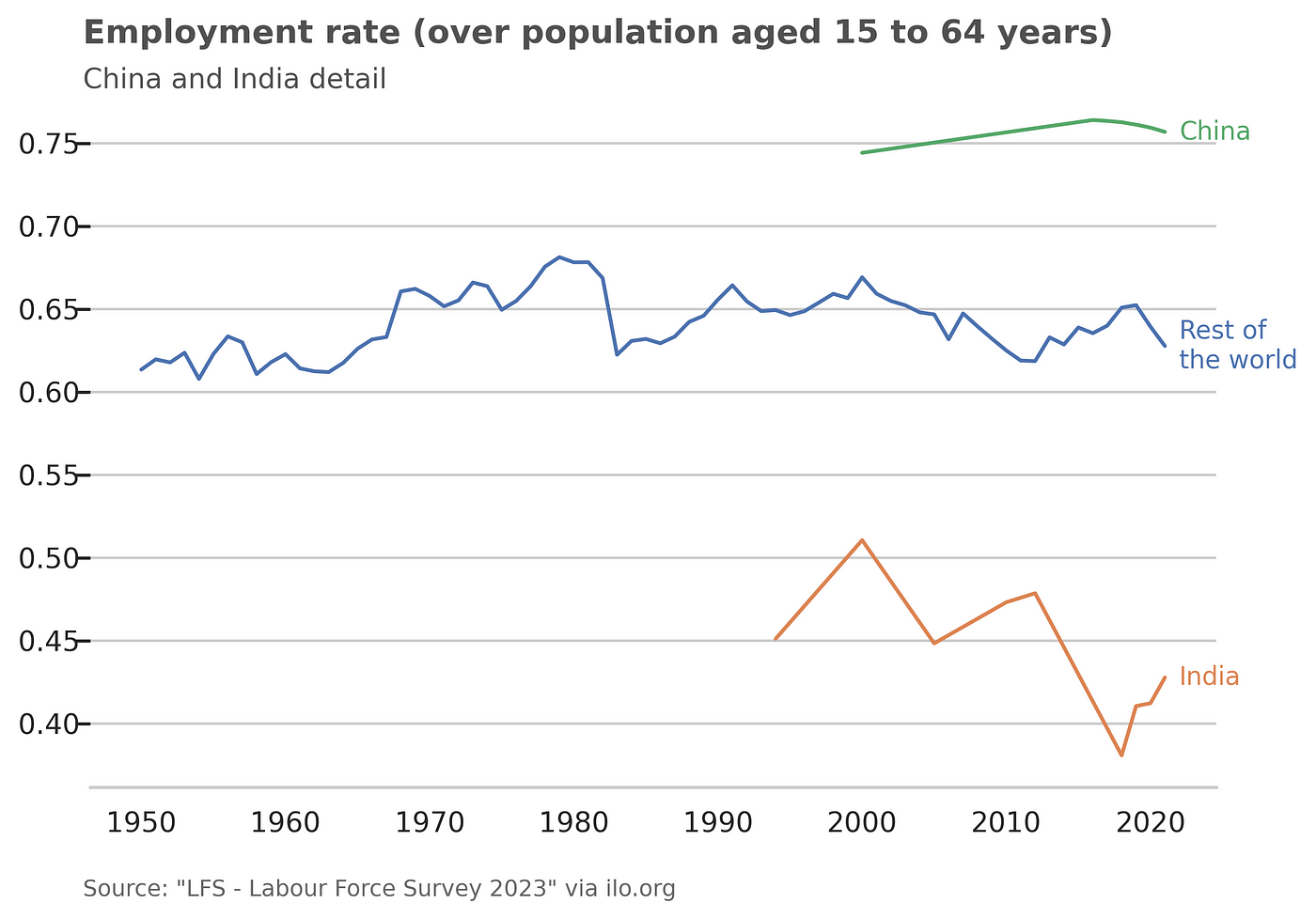
To contribute to the body of evidence that we are not being replaced by technology, let us look at the employment rates in the world since 1950:
Image by author
I put China and India separately because their data was not available for every year and, given their populations, this had a big impact on the variability of the indicator, specially since the 1990s.
We can see that, despite the impressive technological advances over the last 70 years, employment rates do not seem to be a bigger issue now than they were back then.
We are working less
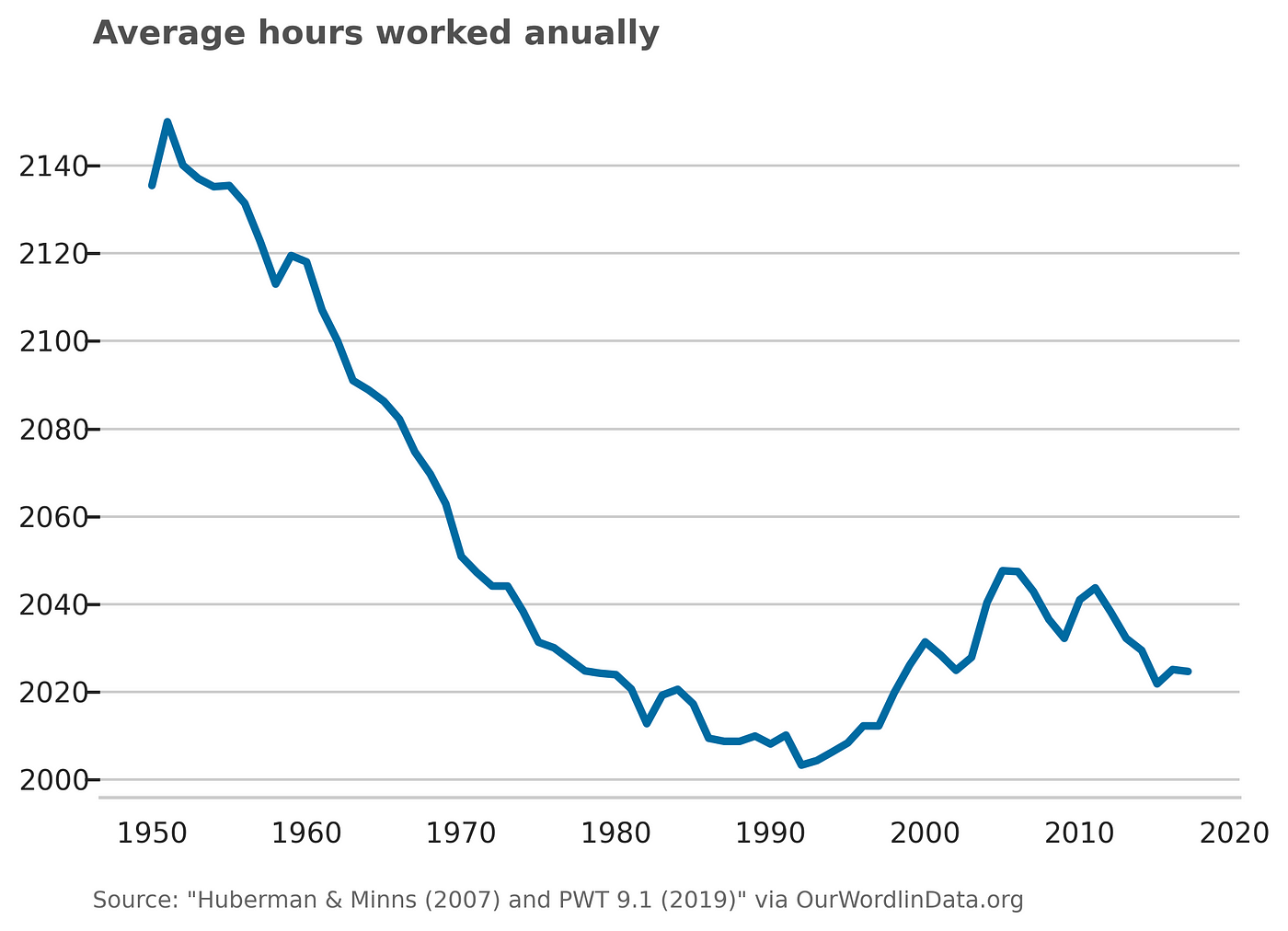
We are, on the other hand, working much less than our ancestors:
Image by author
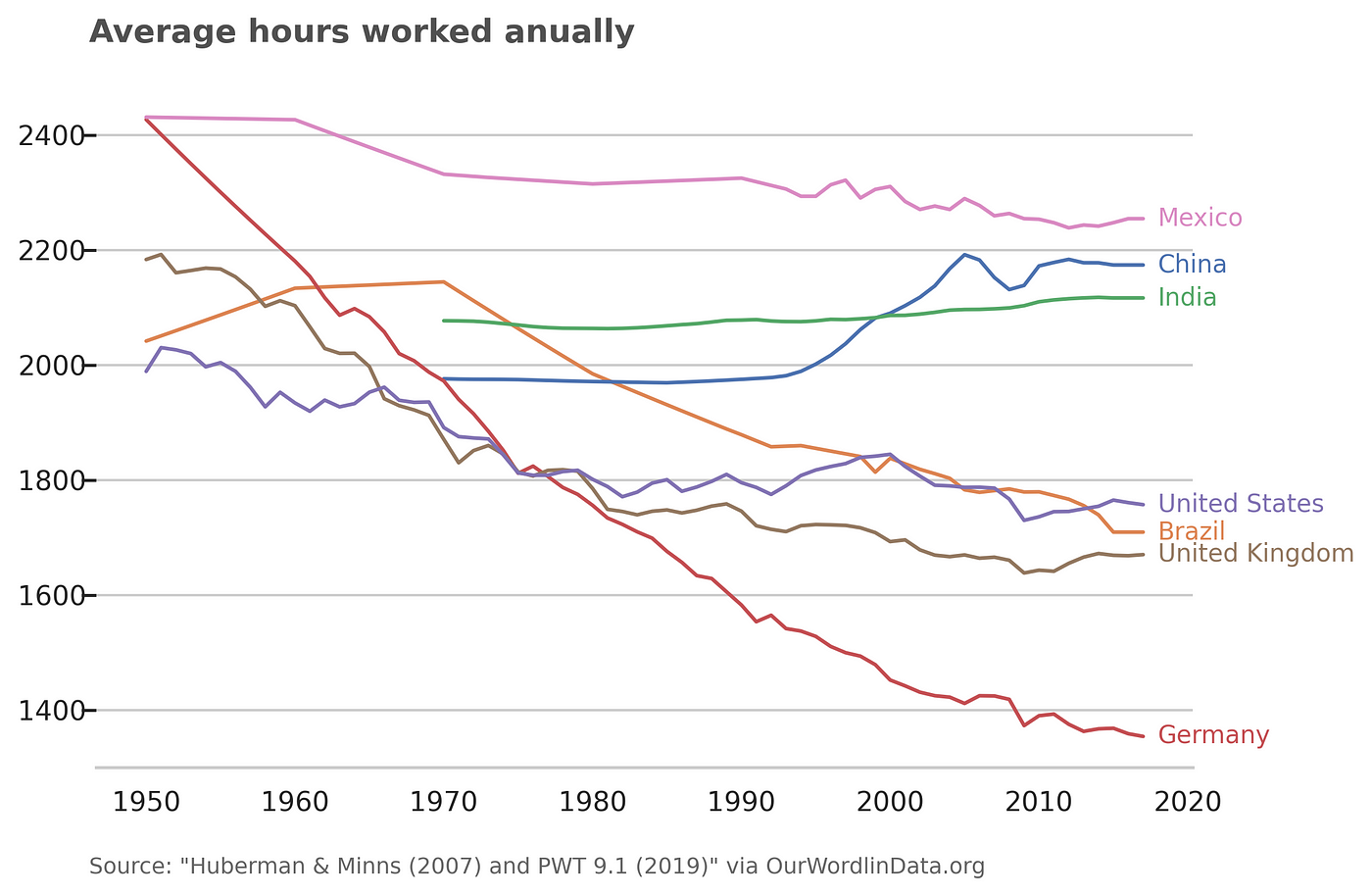
This global trend, however, is not the same everywhere:
Image by author
Richer countries are reducing their working hours at higher rate than the rest. I cherry-picked some specific countries that are representative of different trends:
Germany is an example of a rich country where people worked much more than the rest of the world, and has drastically decreased since then;
The US has become substantially richer since the 1950’s, yet its work load have not decreased significantly;
China and India seem to be going in the opposite direction of the rest of the world, working longer hours.
We are richer than ever
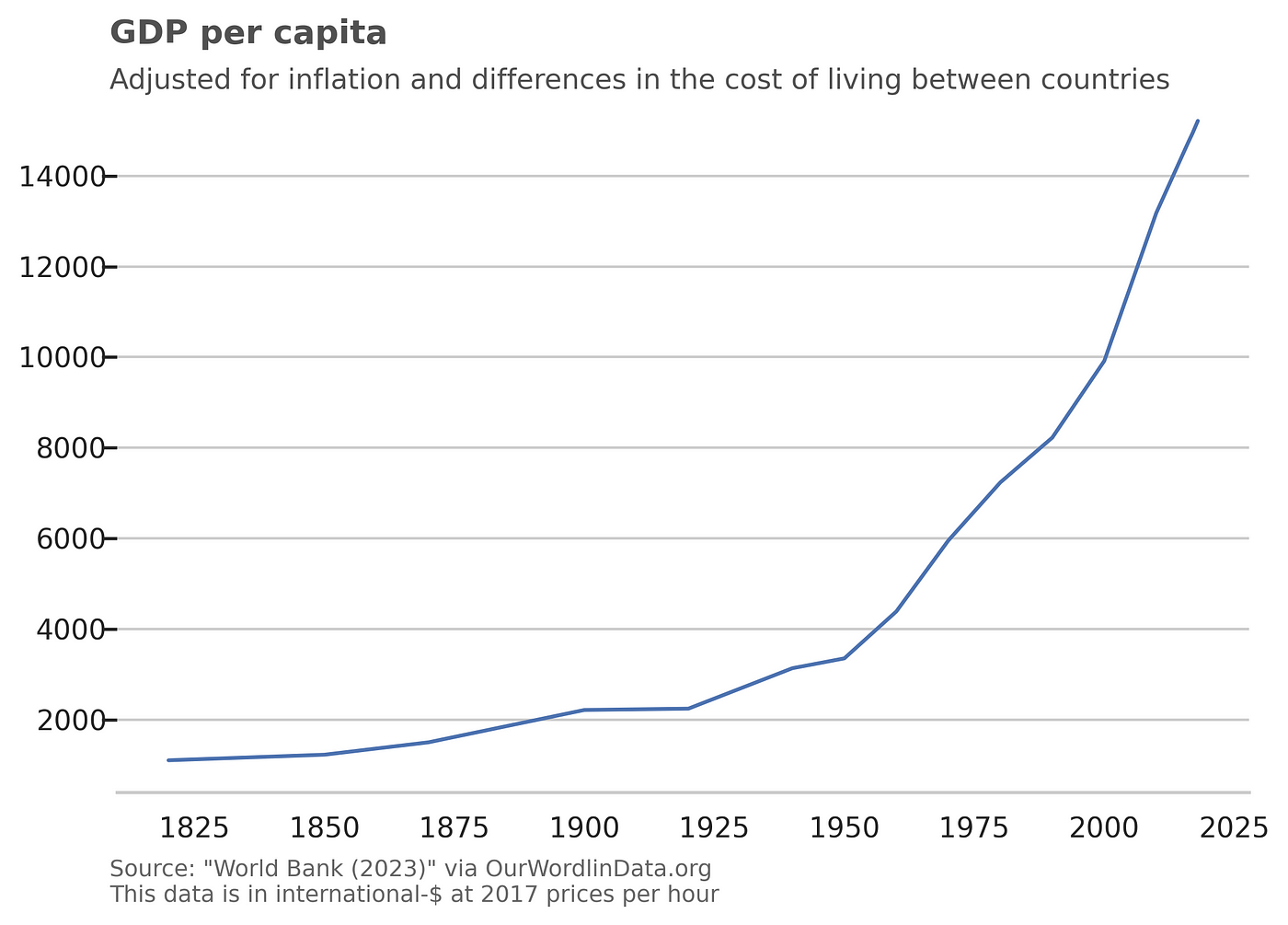
I hope this does not come as a surprise, but we have never been richer:
Image by author
So, even though the world is working less, pretty much every country got richer.
Of course, the distribution of that wealth was not the same across the globe. Pretty much every country got richer, but some got richer than others (again, no surprise):
Image by author
But how can we work less and make more money? What allowed that to happen? Well, we happen to have become more productive over time thanks, in part, to technology.
We are more productive
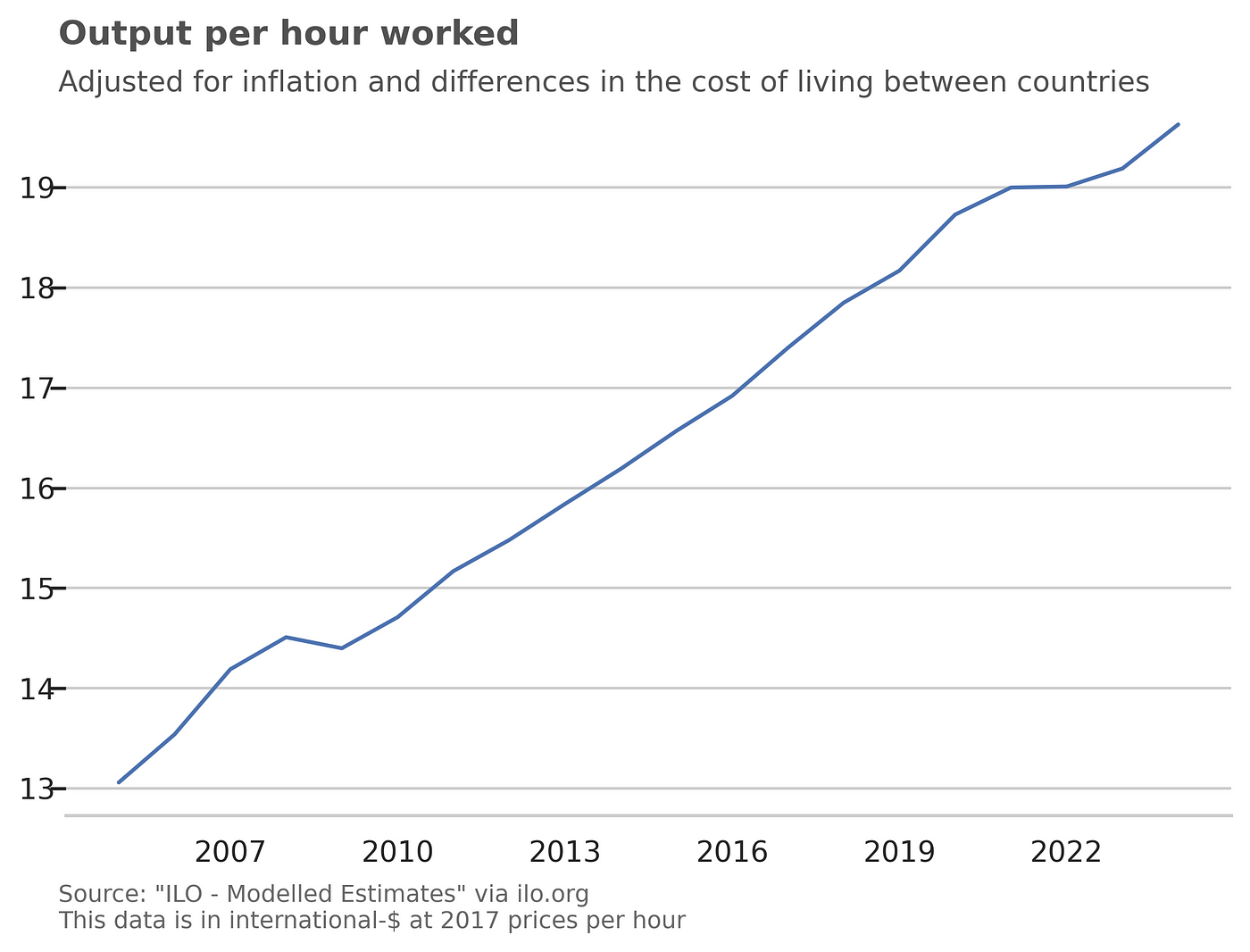
Technology, education and solid institutions contribute to productivity, and we can see the results over the years:
Image by author
Unfortunately, I couldn’t find data older from before the 2000s but, given the decrease in number of hours worked and the increase in GDP per capita, we can see the trend is there and is pretty much strong.
This constant productivity increase over the time is what allows us to work less and make more money.
Things will still change
So, everything will stay the same? Well, no. Of course AI will have an impact in the job market. But the change might be more related to jobs migrating from one industry to another, and from one region to another.
The European Central Bank study [2] suggests that increases in productivity move jobs in two main ways:
less manufacturing jobs, more services jobs
less low-skill jobs, more high-skill jobs
More specifically, we expect more jobs in health, education, and services, and less jobs in utilities, mining, and construction.
Also, in the meta-analysis we saw earlier [1], they identify five key categories of technology measures in the literature, with different impacts on job markets:
Information and communication technology: more high-skill, non-routine, and service jobs;
Robots: the negative impact on employment is generally offset by new jobs related to their production, operation, and maintenance;
Innovation: product innovation seems to create jobs, but the evidence for process innovation remains mixed;
Productivity: job gains were mostly favorable for non-production, high-skill, and service jobs. Nonetheless, the net employment effects observed in these studies are rather negative than positive;
Other: other/indirect measures of technology indicate net job creation effects, particularly for non-production labour, but also for lowly skilled workers, particularly in service jobs.
So we could expect either:
relocation of jobs from manufacturing countries towards service-intensive countries;
a change in the sectorial structure within countries, with an increase of service jobs when compared to manufacturing;
a mix of both.
I imagine these changes could increase inequality due to:
the migration towards high-skill jobs, particularly if education doesn’t keep up;
more money going to capital owners: there is already evidence [2] that the share of labor on national income is decreasing.
We could be wrong, but how?
Of course this whole analysis could be wrong. Let’s try and gather some evidence that goes in the opposite direction, or at least understand in what ways the evidence we saw before could be inadequate.
There are some theoretical attempts to model the Marxist thesis of “labor immiseration”, looking at different axes:
Inter-generational market failure: quick advancements in technology benefit skilled workers and those who own capital in the short term. However, over time, it leads to hardships for people who cannot invest in physical or human capital;
Task encroachment: two opposing economic forces shape how much income goes to labor: technology advancement which replaces ‘old’ tasks, decreasing labor’s share of output, potentially lowering real wages; and internal technological progress that creates new tasks requiring labor. The interaction of these forces may result in a unbalanced growth path;
New tasks might not be created “fast enough”: the number of automated tasks could grow at a higher rate than the new tasks created by automation, leading to a reduction in the number of tasks that can be performed by humans;
These models are theoretical, though: they are not evidence that the net job losses will happen, they just outline scenarios where it could.
There is some evidence showing that this time could be different, and that this relationship between productivity and unemployment might be shifting: recent decades have witnessed more negative own-sector effects of productivity growth, especially in manufacturing, and less positive external effects on other-sector employment, possibly due to increased trade openness. However, this pattern has been seen before, in the 1980s, and it’s not new [2].
Another study, by the National Bureau of Economic Research [5], looks at the impact of increased industrial robot usage in the United States from 1990 to 2007 on local labor markets. The researchers find that the rise in robot usage leads to a significant negative effect on employment and wages across commuting zones. They support their findings by showing that areas most exposed to robots post-1990 did not display different trends before that period. The impact of robots is distinct from other factors like imports from China, decline of routine jobs, offshoring, and various types of IT capital. The conclusion suggests that for every additional robot per thousand workers, the employment to population ratio decreases by about 0.18–0.34 percentage points, and wages decrease by 0.25–0.5 percent. The study focuses specifically on industrial robots in certain local labor markets, which can’t account for the spillover effects on other regions or markets.
Maybe this time it’s different, and AI is such a disruptive technology that it will behave in a different way. Maybe, its relationship with productivity is different than other technologies.
Maybe. But the empirical evidence suggests otherwise, so I wouldn’t bet on it.




 the signal